Lung Cancer in the US
- About 1 in 16 Americans will be diagnosed with lung cancer in their lifetime
- 234,580 people will hear “You have lung cancer” in 2024. That’s one diagnosis every 2.2 minutes.
- Early detection can boost the 5-year survival rate to 64% .
- Of the 9 million Veterans out there, about 1.5 million should be screened for lung cancer
- About 60%-65% of all new lung cancer diagnoses are among people who have never smoked or are former smokers
- Lung cancer takes more lives than the next three leading cancers (colorectal, breast, and prostate) combined
- Only 19% of all people diagnosed with lung cancer will survive 5 years or more, BUT if it is caught before it spreads, the chance of 5-year survival improves dramatically
Introduction
What is Lung Cancer?
Lung cancer often has no symptoms until it has spread (metastasized). This is because there are few specialized nerves (pain receptors) in the lungs. When symptoms do occur, they vary depending on the type of lung cancer and location and size of the tumor. A series of tests are necessary to diagnose lung cancer. Further testing can identify the type and stage of cancer, which help determine treatment options.
Lung cancer begins in normal lung cells that have been altered in such a way that they no longer behave like a normal cell. These abnormal cells grow in an uncontrolled fashion, causing harm or invading normal tissue, and may even spread to other parts of the body.
Once thought to be a single disease, research has shown that lung cancer is actually a group of diseases characterized by what type of lung tissue the abnormal cells originated in (the “histology”) and what type of changes or mutations have taken place in the altered cell ie: presence of molecular proteins (“markers”).
Knowing the specific type of lung cancer is critical to guiding treatment decisions and personalizing a patient’s management, and ultimately improving quality of life and optimizing chances for survival.
We take around 23,040 breaths a day, constantly exposing our lungs to the surrounding environment. If you have lungs, you can get lung cancer. Lung cancer is more treatable if it is diagnosed early. But, since lung cancer symptoms rarely show up until the disease is advanced, it is important to know if you should be tested.
Know the signs, symptoms and risks for lung cancer.
7 Signs of Lung Cancer You Should Know
Lung cancer often has no symptoms until it has spread (metastasized). This is because there are few specialized nerves (pain receptors) in the lungs. When lung cancer symptoms do occur, they vary depending on the type of lung cancer and location and size of the tumor. Some lung cancer symptoms are similar to those of other common illnesses.
Types of Lung Cancer
Lung cancer is when cells of the tissue of the lungs grow out of control. This growth causes problems such as the creation of a mass (tumor). Lung cancer can affect the tissue surrounding the mass and interfere with the organ function. It can also break away from the original mass and spread to other parts of the body (metastasis).
Cancer Ambassadors Program Inc.
To be an ambassador for your own health, it is important that you take the time to learn about your chronic health condition and the health care options available to you. You don’t need to have any sort of formal scientific education to improve your understanding of your medical condition and how they are treated, just a willingness to learn and someone to point you in the right direction. There are many tools and resources available to help you get started on this journey of discovery and assist you along the way.
My Choices: A Planner for Healing (c)
Introduces users to the exploration of health care options that contribute to wellness. Patients and their caregivers may download or view in PDF or HTML formats at no charge on our Internet site.
Health Care Question Builder and Lung Cancer Question Builder
Tools that take patients through a series of questions they may want to ask their healthcare team. The user clicks all the questions they would like to ask, and then the program generates a customized list to print out and share with their team or save on the computer.
Lung Cancer Choices 6th Edition
A decision aid and resource book proving information about lung cancer diagnostics, treatment, and management options, including supportive and complementary therapies, clinical trial information, and lifestyle management. This patient-focused book written by medical experts is available in PDF and HTM formats at no charge on our Internet site.
Caregiver Choices
Includes information and support for caregivers of lung cancer patients.
Learn From the Experts
A series of community video-casts based on our book, Lung Cancer Choices.
Topics include Biomarkers, Nutrition, Sexuality, And Integrative Medicine, Complementary Therapies, and Chinese medicine.
The videos can be viewed on our internet site and on You Tube.
Stories of Hope
PO Box 1748
Oregon City, OR 97045
503-632-9032
Lorren Sandt
Executive Director
Free to Breathe
A lung cancer advocacy organization that works to increase lung cancer awareness and to fund research with the greatest potential to save lives. Free to Breathe supports a nationwide network of grassroots lung cancer advocates through its program. Information and free publications about lung cancer are available on their website including an information kit for newly diagnosed patients.
One of the booklets titled, “Living with a Diagnosis of Lung Cancer” is available in Spanish.
Additional Resources: Free Patient and Awareness Resources (including Information Kit for Newly Diagnosed Patients
You are not alone. We are here with services and referrals to assist you with your cancer journey. All our services are provided free of charge.
Call free-of-charge for support, questions and resources.
HELPLINE
John Atkinson Lung Cancer Foundation
Since 2011, the scholarship program has been proud to award 80 scholarships to children around the United States totaling nearly $100,000. Our hope is to ease some of the financial strain placed on families who have lost a parent to lung cancer.
Since John Atkinson was a parent of three children, this is the best way to honor his memory and carry out his legacy.
Students are awarded up to $2,500 to be used at a college, university, or vocational/trade school. The scholarship is not renewable.
Lung Cancer Center
Lung Cancer Center is here to provide the information and resources you need to understand the diagnosis. Are you a patient, loved one, caregiver, or even just a student? Learn more about what a lung cancer diagnosis is and the best way to fight it medically and legally.
Lung Cancer Foundation of America

Lung Cancer Foundation of America (LCFA) is dedicated to the research, communication, and education surrounding lung cancer. While funding young researchers is our passion, LCFA also serves as a resource for patients or anyone seeking answers, hope, and access to updated treatment information, scientific investigation, and clinical trials.
LCFA’s mission is the improvement in survivorship of lung cancer patients through the funding of transformative science. LCFA has been instrumental in developing a continuing public dialogue. LCFA will raise the public’s awareness and serve as a resource for patients or anyone seeking answers, hope, and access to updated treatment information, scientific investigation, and clinical trials. Through annual media campaigns, LCFA has been dedicated to education and research – the route to the early diagnosis and treatment of lung cancer and, hopefully, the cure.
Our site is a testament to our journey and commitment. It is brimming with the latest lung cancer insights, support tools, and ways to get involved.
- Learn how lung cancer screenings save lives
- Find a Story of Hope from people living with lung cancer
- Use the Keyword Search bar to select a story by biomarker or stage
- Download resources that will support you through your lung cancer journey
I invite you to explore our new digital home. Let’s continue to empower hope and advance science together.
We recognize the incredible achievements of women in lung cancer research, specifically early career researchers like Dr. Kellie Smith, Dr. Triparna Sen, and Dr. Alice Berger. These trailblazing women, supported by LCFA, are at the forefront of pioneering studies that are propelling the field of lung cancer research into exciting new directions.
Follow, share, and engage with LCFA online — your support amplifies our voice and creates a ripple effect of hope and unity in the fight against lung cancer. Use #LCFAVoices #MinorityHealthMonth or #LivingWithLungCancer.
Your actions inspire hope. Your support drives scientific progress. Your voice is the one that will help transform lives.
We are seeing a concerning trend of increased lung cancer diagnoses among young women, and your donations directly fund the research that could reverse this tide. By contributing to LCFA, you are investing in a future where every young woman has a fighting chance against lung cancer.
Recently diagnosed with lung cancer?
Learn more about your lung cancer diagnosis. What questions should you be asking? What are the most important next steps? Know that you have options and remember that knowledge is power.
Looking for stories about patients living with lung cancer?
Read fascinating Living With Lung Cancer stories. Illustrating advances in lung cancer research, these stories share hope that as patients are provided the right treatment at the right time, lung cancer survival statistics will change.
Read #LivingWithLungCancer stories
Lung Cancer Foundation of America is so proud of their Speakers Bureau. The speakers’ lives have been affected by lung cancer. Spreading awareness, information, and hope in the fight against the leading cause of cancer death, LCFA’s bureau speakers are available for interviews with the media.
Thanks to advances in technology, early detection screening using spiral CT has been shown to reduce lung cancer deaths by 16% to 20%, compared to standard chest x-rays among adults. Yet, only 16% of people will be diagnosed in the earliest stage, when the disease is most treatable. The need for more research is vital to improving detection, diagnosis, and treatments. Join LCFA’s fight for more lung cancer research funding.
LCFA has been instrumental in developing a continuing public dialogue. Through annual media campaigns, LCFA has been dedicated to education and research – the route to the early diagnosis and treatment of lung cancer and, hopefully, the cure.
A recent multicenter study published in The Lancet highlights the promising efficacy of immunotherapy in advanced lung cancer patients. The study, conducted across multiple institutions, aimed to evaluate the effectiveness of immune checkpoint inhibitors in treating patients with advanced non-small cell lung cancer (NSCLC). The findings reveal that immunotherapy significantly improved overall survival rates compared to standard chemotherapy, establishing it as a viable treatment option for this patient population.
Ultra-sensitive RNA Detection Method for Early Lung Cancer Diagnosis
Researchers have developed a breakthrough ultrasensitive method for detecting RNA biomarkers that could revolutionize early lung cancer screening. This advancement could significantly improve the 22% early-stage detection rate that currently limits treatment success, potentially saving thousands of lives through earlier intervention when survival rates reach 64%.
| Discover more |
Digital Framework Revolutionizes Lung Cancer Screening Coordination
Jefferson Health System created a digital framework standardizing lung cancer screening data across 11 sites, using electronic health records to eliminate duplication and improve care coordination. This integrated approach demonstrates how technology can optimize screening programs to improve early detection and reduce the 125,070 annual lung cancer deaths.
| Get the details |
Study reveals why most life-long smokers never develop lung cancer
New study reveals genetic factors protect some lifelong smokers from lung cancer, identifying robust mechanisms that limit mutation accumulation and improve early detection strategies
| Dive Deeper |
Whether you are looking for information on lung cancer, have been recently diagnosed, have lost a loved one, or would like to help Lung Cancer Foundation of America achieve our mission, please use the information here to contact us. We are eager to answer your questions or help you navigate your lung cancer journey.
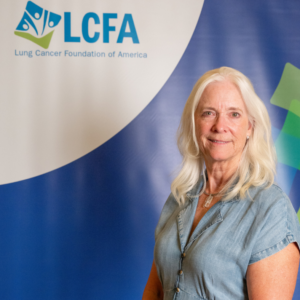
Kim Norris
Co-Founder and President
Lung Cancer Foundation of America
7381 La Tijera Blvd
#451663
Los Angeles, California 90045
ACCEPTS VIRTUAL CLIENTS
323.741.4713
[email protected]
Every month, our Lung Cancer Living Room sessions bring hope to patients and their families.
LUNGevity Foundation
LUNGevity is transforming how people are diagnosed and live with lung cancer through research, education, and support.
We are dedicated to funding scientific research because the link between research spending and improved survival is clear. Our strategic investment in both early detection and therapeutics will help people live better with lung cancer and dramatically improve on the current 19% five-year survival rate.
LUNGevity initiatives position us as thought leaders in the lung cancer advocacy community, providing programs and driving change for those with lung cancer today and in the future. While we fund primary research, we also conduct patient-focused research to better understand the unmet needs and convene multi-stakeholder meetings to streamline the research process and accelerate progress to patients.
LUNGevity seeks to empower patients to be active decision makers in their treatment process through our extensive educational resources, online peer-to-peer support, and in-person survivorship programs. We provide a community of empowerment, support, and hope.
LUNGevity is the nation’s leading lung cancer organization investing in lifesaving translational research and providing support services and education for patients and caregivers.
LUNGevity’s goals are three-fold: (1) accelerate research to patients, (2) empower patients to be active participants in their treatment decisions, and (3) remove barriers that patients face in accessing the right treatments.
LUNGevity Foundation is firmly committed to making an immediate impact on increasing quality of life and survivorship of people with lung cancer by accelerating research into early detection and more effective treatments, as well as by providing community, support, and education for all those affected by the disease. LUNGevity’s comprehensive resources include a medically-vetted website, a toll-free HELPLine in partnership with CancerCare®, a unique Lung Cancer Navigator app, peer-to-peer mentoring for patients and caregivers (LUNGevity LifeLine), and survivorship conferences. LUNGevity also helps patients find and navigate clinical trials through our Clinical Trial Finder tool, a Clinical Trial Ambassador program, and participation with EmergingMed.
Our vision is a world where no one dies of lung cancer.
For more information about LUNGevity Foundation, a four-star Charity Navigator organization, please visit www.LUNGevity.org.
P.O.Box 754
Chicago, Illinois 60690
Navigate clinical trials and treatment options with guidance from specialists.
PAN Foundation
Offers support for Non-Small Cell Lung Cancer patients. PAN will assist underinsured patients with the out-of-pocket costs associated with their medications.
Patients diagnosed with Non-Small Cell Lung Cancer can now apply for assistance with PAN online, over the phone, through their specialty pharmacy, or their provider’s office.
Qualified patients will be granted $7,500 annually to cover copayments, coinsurances, and deductibles. Patients who earn up to 400 percent of the Federal Poverty Level – $60,520 for a family of two – are eligible for assistance. Patients can apply for assistance online at www.PANfoundation.org or by calling 1 866 316 PANF (7263).
Phone Buddy
Connect with lung cancer survivors who have walked in your shoes.
Leave a Reply