It’s time to talk Teddys!!!! 


Teddy Bear Clinics are a special medical play intervention often used by Child Life Specialists to help empower kids through medical procedures. While they are frequently used with children who are receiving medical care, they are also effective for kids who have a parent or loved one with cancer.
We hear all the time that young kids start to fear going to the doctor when they see their parents returning home from the clinic looking so sick and tired from treatment. Teddy Bear Clinics give these kids a valuable tool to ask questions, process their feelings, and feel more confident about going to the doctor.
Our Teddy Bear Clinic at Home packages are intended for children who have a parent or loved one with cancer. They include everything needed for parents or caregivers to help their children engage in curious medical play, including medical supplies, activity sheets, and guides that explain the process.
These kits are best suited for children ages 2-10.
When you request a Teddy Bear Clinic at Home kit,
you will receive:
A package of medical play supplies
Activity sheets and caregiver guide
Tools to support open-ended creative play
Your child can choose a favorite stuffy, doll, or action figure to be the “patient” while they dress up as the doctor, nurse, or surgeon. Kids often return to this kind of play again and again — processing their experiences in ways that feel safe, familiar, and even fun.
Parenting through cancer is unpredictable. Teddy Bear Clinic@Home offers your child a simple, meaningful tool to support them … whenever they are ready.
There are two ways to get these packages to parents:
1. Parents can request their own package, sent straight to their door, HERE.
2. Clinics and non-profits can request up to 5 free packages HERE.
Email me with any questions.
[email protected]
Our Mission
Bright Spot Network provides young cancer survivors who are parents of small children with a safe space for individual and familial healing, recovery, and reconnection.
We focus on young parents and guardians caring for young children at the time of diagnosis, including those diagnosed during pregnancy.
Our Values
We value empathy, equity, and justice. Our community is built on trust and authentic connection. We hold hope and healing alongside grief and loss.
Who We Serve
Bright Spot Network serves families where a parent, or primary caregiver, of a preschool-age kid (ages 0-10 or pregnant at the time of diagnosis) has cancer. We serve people from diagnosis to survivorship, those in active treatment and living with cancer, understanding that a cancer “journey” can be long for the patient and their family.
Bright Spot Network provides a safe space for individual and familial healing, recovery, and reconnection.
Check out our resources!
In addition to our services and programs, we have also put together helpful resources to help you and your family navigate a cancer diagnosis with children.
Resources→
Here are links to our ongoing programs, all free of charge and open to any family living in the United States:
- Bright Grants ($500 barrier-free grant for parents in treatment)
- Bright Reads (free children’s books about cancer, big emotions, end of life) & Discussion/Activity Guides for each book!
- Bright Box (free art boxes for young children and their parent/caregiver)
- Connections for Kids
- Family Resource Navigation
- Virtual Support Groups for Parents
- Resources for Parents
Warmly,
Carissa

Our Founders’ Stories
Haley Pollack
Co-Founder and Executive Director
[email protected]
During my first pregnancy, I began to suffer from stomach pains but they were always fleeting. After the birth of my second baby, it was worse but explainable: I *just* had a baby. I was nursing. I was working full time. I was tired. My husband had been encouraging me to see my doctor but it all seemed so silly … after just having a baby, who didn’t feel unlike themselves?
My doctor ordered a number of tests, and then some more, and some more after that. Finally, I learned I had Stage III Colon Cancer. At 37 years old, with a 6-month -old and 3-year-old at home, I went through major surgery and 8 rounds of chemotherapy.

Cancer runs in my family. My mom died from breast cancer when she was 58. I had always assumed that I would eventually get breast cancer. Still, I thought of myself as healthy. I was smart, getting early mammograms and staying on top of new research. It never occurred to me that I would get cancer before 40 and that, of all places, it would be on my colon.
When my mom was first diagnosed, I was 16 years old, so I have some sense of what cancer can do to a family. And yet, those many months after diagnosis were impossibly hard and I am still grieving the precious time I lost with my young kids.
There are relatively few resources for young families wading through a cancer diagnosis. I am lucky for the foresight of a handful of healthcare professionals who connected me with other young people like myself. Those connections bred conversations about talking to kids about illness, but also our careers, our partners, and our questions for what a post-cancer-diagnosis-life might look like.
I am endlessly grateful for the conversations and connections. I know that Bright Spot Network will begin to fill the gap for other young people and their families.
Aimee Barnes
Co-Founder and Board President
[email protected]
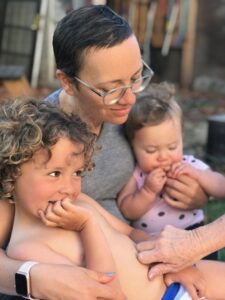
In September 2018, I was diagnosed with breast cancer while 38 weeks pregnant. I was 36 years old and had a four-year-old son. My daughter was born the day after I received my diagnosis. My husband and I were completely blindsided. I had no family history of cancer and had always been in good health.
During my pregnancy, I had day-dreamed about all the things I would do with my daughter during my maternity leave. Instead, that time was used for 16 rounds of chemotherapy, a mastectomy, and five weeks of radiation.
The path of treatment was incredibly difficult – physically, psychologically, emotionally – both for me and my family. I often felt robbed of precious time during my children’s earliest days – time that would have felt fleeting even under normal circumstances.
Because a cancer diagnosis is relatively uncommon among young parents, there are few resources available to support us. I found that many of the resources that did exist were targeted at people 15-20 years my senior, and those targeted at the “younger crowd” generally didn’t account for the additional challenges presented by navigating a cancer diagnosis with small children.
Through informal introductions by my doctors and friends, I was able to connect with other young parents who were facing similar cancer diagnoses, creating a critical support system. We often discussed this feeling of lost time, as well as a lack of cancer resources available for people like us – young and with small children. And we dreamed about the things we would do, the trips we would take, and the time we would spend with our kids and partners when we finished our treatment.
Here are links to our ongoing programs, all free of charge and open to any family living in the United States:
- Bright Grants ($500 barrier-free grant for parents in treatment)
- Bright Reads (free children’s books about cancer, big emotions, end of life) & Discussion/Activity Guides for each book!
- Bright Box (free art boxes for young children and their parent/caregiver)
- Connections for Kids
- Family Resource Navigation
- Virtual Support Groups for Parents
- Resources for Parents
Carissa Hodgson LCSW, OSW-C
Director of Programs & Community Outreach
[email protected]
PO Box 3090
Alameda, California 94501
Leave a Reply